
Magnetic gradiometer surveys have long been an application for mineral exploration surveys, particularly for near surface targets.
An original configuration is the vertical gradiometer which “pre-conditions” the survey to shallow depths. However, Terraquest flies the Horizon™ airborne horizontal gradient survey for a variety of other reasons, including to provide the highest and most accurate targeting – which is only possible through sensitive gradiometric measurements — in many cases.
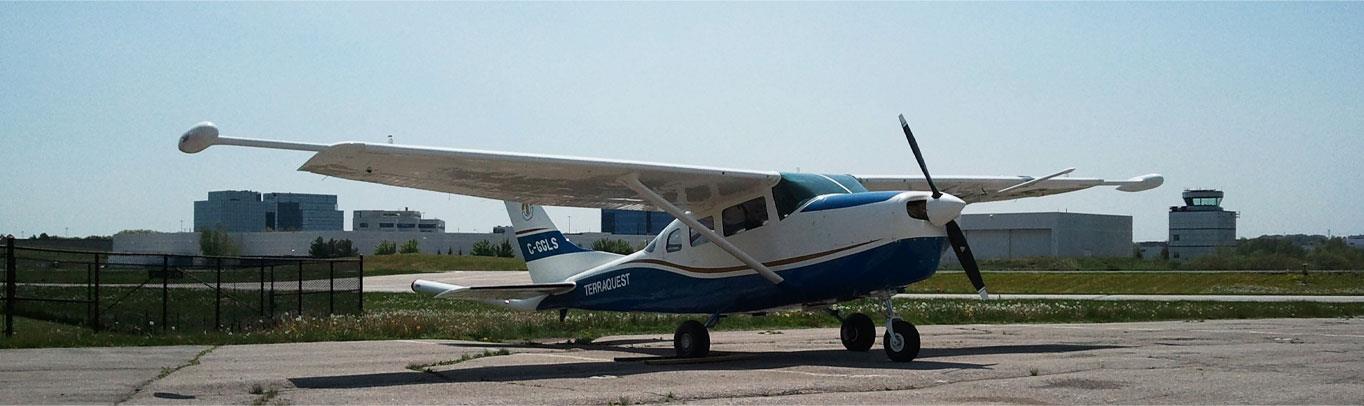
Survey technique is also a key consideration in planning these surveys, and Terraquest begins by careful survey planning; calibration of systems; and then, data acquisition, processing, and interpretation. The configuration of the airborne geophysical survey platform is shown below — with two wing-tip pods representing the housings for each side of the horizontal gradient array (and a third pod on the tail – not shown).
Terraquest’s-Cessna 206 aircraft with Horizon™ Grad set up and wing tip pods on each tip of the wings and the tail.
Terraquest is a master in ultra-slow and low flying as required for better data and results from this method.
Deliverables
In addition to magnetic products derived independently from each sensor, Terraquest provides a complete range of deliverables including high resolution Horizontal Gradient Vector Images, such as the one shown below.
Terraquest Ltd. is able to provide updated preliminary map images within 48 hours of acquisition.
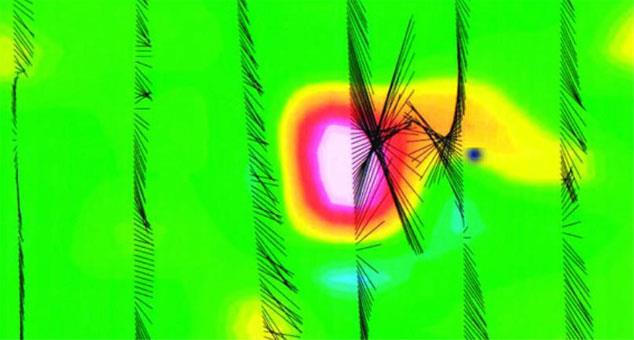
Plan map showing Horizontal Gradient Vectors overlaid on magnetic data. Magnetic data show a target on the line; Horizon™ Grad data show the true target for drilling is between lines.
Benefits
The main advantage of Terraquest’s Horizon™ airborne horizontal gradiometer survey is that it paves the way for enhanced resolution through improved gridding and contouring (gives data both on and between the lines; more information in general). Explorers can also benefit from higher precision in locating small anomalies between flight lines and also in locating faults, dykes, and contacts more accurately.
Other benefits are specifically focused on the geologists, including defining magnetic axes within magnetic units, defining the dip of units, and distinguishing between culture and small geological signals, such as those from kimberlites.
Applications
Airborne horizontal gradient surveys are best utilized where targets are shallow and where high resolution and drill targeting ability are required. Natural application fits include kimberlite exploration.
Case Histories and Reference Information
Kimberlite targeting case history
Technical Considerations
For explorers interested in technologies associated with the Horizon™ airborne horizontal gradient survey, the system is based upon three latest-technology cesium vapour sensors, mounted on extensions from each wing tip and tail.
The sensors give a 0.005 nT sensitivity with recording at 10 to 20 times per second for high density coverage. Noise is constrained through a +/- 0.02 nT fourth difference noise envelope.
In terms of data acquisition and navigation, Terraquest uses AGIS and SDAS fully integrated data acquisition systems with real time corrected GPS. Also included is digital video flight path confirmation at 1/10 second with fiducial and GPS location registration over print. Radar and Barometric altimeter data are simultaneously recorded.
For More Information
Terraquest would be pleased to discuss Horizon™ airborne horizontal gradient surveys and interpretation approaches with you, including inversions of existing or planned data. For more information, click below.
