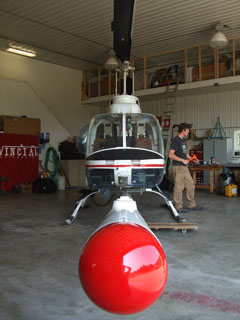
Electromagnetic or VLF-EM surveying

 steve
steve
Electromagnetic or VLF-EM surveying

The acquisition of Airborne magnetic data is the first step in the exploration process, providing geologists with detailed mapping of magnetic field and anomalies. The magnetic data is then interpreted by Geophysical consultants to further pinpoint areas of interest to continue the exploration process. Aeromagnetic surveys acquire the data necessary to create geophysical maps, and … Read more
Gravity surveying is the process of measuring the local gravitational field of the Earth. Airborne gravity is the process of measuring and mapping these changes in the gravity field with an airborne gravimeter on a helicopter or an aircraft. It involves using ultra-sensitive equipment, called a gravimeter, to look at the structure density of rock … Read more
Do I need a licensed geophysical surveyor to perform airborne geophysical surveys? The answer is that a professional operator will have all licenses, certificates and inspections readily available for the client to view prior to signing a contract. Licenses protect the safety of all involved and are a necessary cost in exploration services.< Specialists in … Read more
How long do airborne geophysical surveys generally take? Is it something that can be done in a single day? A small property sized survey can be performed in a day; however, most surveys require several weeks. Large airborne geophysical surveys for major projects may take months of acquisition time. Specialists in Airborne Geophysical Surveys Terraquest … Read more
The advantages of airborne surveys include low data acquisition costs; widespread coverage; detailed coverage as required; high resolution; and in some cases, the ability to drill directly from the survey results. On the other hand, ground geophysics supports additional methods not possible in the air, including: And so, in reaching a brief conclusion, it can … Read more
Radiometric Surveys Radiometric Surveys detect and map gamma rays, and can be performed on the ground, in the air, or in a borehole. Airborne gamma-ray spectrometry or radiometric surveying for mineral exploration measures the gamma-rays that are emitted from naturally occurring radioactive isotopes that are found in rocks and soils near the surface. The most abundant of … Read more
Why Use Aeromagnetic Surveys? Aeromagnetic surveys are an efficient geophysical prospecting tool for many mineral and petroleum exploration companies and government agencies. A fixed-wing airplane or helicopter is extensively modified to be magnetically quiet and equipped with wingtip pods, a tail stinger, or a towed bird to house magnetometers for acquiring magnetic data. This type … Read more
Finding the Best Airborne Geophysical Survey Companies The best global geophysical survey companies will be able to plan and execute effective geophysical surveys in any area of the world. Successful airborne geophysical survey providers know how to safely acquire high quality geophysical data, which can be used to enhance exploration and engineering projects. Acquiring accurate … Read more
Facts About Electromagnetic Surveys Electromagnetic (EM) geophysical surveys are based on the propagation of electric currents and electromagnetic fields in the earth. EM surveys can be conducted as airborne, ground or borehole surveys, and is one of the most commonly used methods in mineral exploration. In EM surveys, an electric current is transmitted through the … Read more
