
Magnetic Surveys: These detect variations in the Earth’s magnetic field caused by the presence of kimberlite pipes, which often have different magnetic properties than surrounding rocks.
Gravity Surveys: These measure variations in the Earth’s gravitational field to identify denser kimberlite pipes.
Electromagnetic Surveys: These detect the electrical conductivity of the ground, which can help identify kimberlite pipes.
Radiometric Surveys: These measure natural radioactivity to identify kimberlite pipes.
Case History: Enhancing Kimberlite Targeting with Gradients using the Horizon™ Grad System
The search for diamonds typically revolves around their host rocks, kimberlites. Kimberlites are the light rocks that travel through the earth’s crust driving diamond formation through intense pressure and heat acting upon naturally occurring carbon.
These deposits are located geographically around the world with some of the largest deposits in South Africa, Russia, and Canada. As such, there is an interest in methods that can assist in the detection of kimberlitic bodies for targeting.
Fortunately, kimberlites have several distinctive features which make them amenable to evaluation including shape, surface conductance, and magnetic signature (in contrast to adjacent rocks).
Terraquest’s high-resolution airborne horizontal gradient survey was the source of data shown in this case history. A horizontal gradiometer survey uses two separate horizontal magnetometers to record data simultaneously on two sides of the aircraft platform. This approach has many advantages as discussed below.
Putting a Horizon™ Grad Survey into Action
In working on the project, Terraquest’s survey design personnel were led by several factors including the effectiveness of horizontal gradiometer surveys for detecting near surface magnetic sources. It was also determined that a slow and low altitude flight would be optimal for the survey according to modeling.
As the first survey contractor to operate a commercial horizontal gradient system starting in 1989, it was not long before Terraquest’s airborne survey began to see results on the project. The survey area was over an Alberta kimberlite, using a Cessna 206 platform equipped with a proprietary Horizon™ Gradiometer (HG) system, acquired the data shown below.
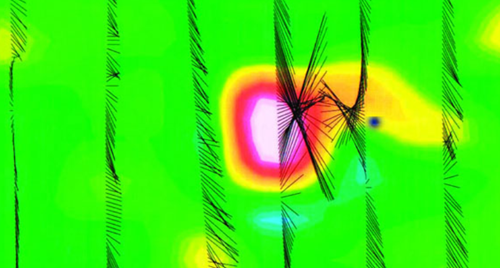
The specific results are that:
- Drill targets are located correctly between the flight lines.
- The single sensor mag is used to measure the Total Magnetic Intensity (TMI) shown as the colour image erroneously shows the kimberlite centered on the flight path
Applying a New Interpretation Approach to Greenstone Exploration
Inversion is a method that develops a model of the data from a priori acquired geophysical data. It is typically applied to magnetic and other forms of data, in this case, VLF-EM. With this data, the objectives were to:
- Characterize rock types by their inherent resistivity
- Enhance the resolution of contacts between lithologies
- Augment the conductor axis provided by the total field amplitude
- Identify resistivity lows commonly associated with contact zones, alteration, and mineralized structures
- Surface mapping can be continued downwards by progressive depth slices
- Map the surficial conductivities separately from the deeper bedrock responses.
Here, a detailed inversion was performed on the data, which to our knowledge, is the first time airborne VLF-EM data from a typical greenstone terrane in North America have been inverted. The interpretation successfully enabled refinement of high priority targets and definition of key geological features.
In summary, resistivity products — derived from the inversion of airborne Matrix™ VLF-EM data from a typical greenstone belt with thin overburden — provide an inexpensive technique to identify and map near surface bedrock lithologies; structure; alteration; and mineralization in gold exploration.
