
VLF-EM is a geophysical prospecting method that was a mainstay of exploration during the 1970’s through 1990’s. Its popularity declined somewhat with the advent of high-powered, deep imaging time domain electromagnetic surveys.
However, VLF-EM still has a valuable role to play in exploration, particularly in diamond and gold exploration as shown in the implementation of Terraquest’s Matrix™ airborne VLF surveys. A case history presented later shows this survey in action with a kimberlite deposit situated in Northern Alberta, Canada. A separate gold case history is provided as well.
The basic premise of Terraquest’s Matrix™ airborne VLF-EM survey is the use of ultra-low frequency electromagnetic waves emanating from ground-based navigation stations. These waves penetrate the near surface of the ground, making them an ideal tool for shallow exploration.

Terraquest test data showing magnetics at top and Matrix™ VLF-EM results at bottom.
The VLF-EM data shows three directions for conductors located to the west, centre and east of the map.
Terraquest offers surveys based on the advanced Matrix™ Digital VLF-EM frequency system that was designed and built by Dr. Petr Kuzmin of Magenta Geophysics Ltd. at Terraquest’s request.
The Matrix™ VLF-EM system is a modern, light weight, digital, passive system that utilizes continent-wide communication VLF radio signals as a power source to energize ground conductors. Signals are received on three axis by 3 orthogonal coils and recorded independently from up to four VLF stations.
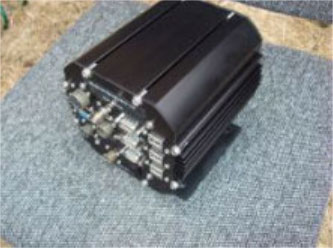
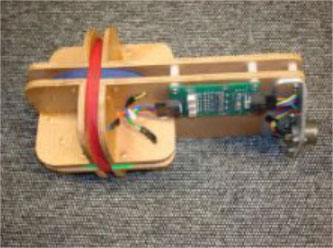
Digital power and acquisition system and Matrix™ 3-axis VLF-EM sensor.
Some of the system characteristics are shown below:
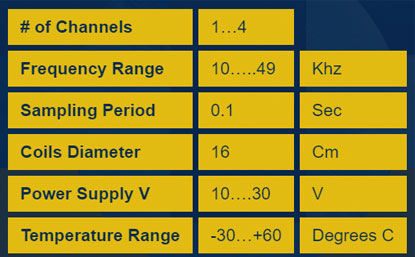
Operating characteristics of the Matrix™ airborne VLF-EM system used in Terraquest’s airborne geophysical surveys.
Deliverables
With the results being fully digital, Terraquest is able to deliver a full range of products, including vertical and planar ellipticities, conductor amplitude total field peak detection, tilt, and azimuth to the transmitter separately for each frequency.
Benefits
For explorers, the benefits of Matrix™ VLF-EM that contribute to Terraquest’s high quality data acquisition including high resolution data from state-of-the-art-circuitry; isolation of data from three coils so that data is cleaner; and simultaneous monitoring of up to 4 independent and customizable VLF frequencies — meaning that full advantage of source-target coupling geometries can be achieved. Other tangible benefits from Terraquest’s airborne VLF surveys include:
- Full parameterization of anomalous VLF-EM signals – including angular and ellipticity components – for maximum flexibility for integration and advanced modeling and interpretation.
- The proven effectiveness of VLF-EM technology in mapping structure effectively and economically, to unravel structural complexities.
- Ability to map fine-grain, low conductivity, and more disseminated structures.
- Low cost alternative to deeper seeking active EM systems.
Applications
Terraquest’s clients for Matrix™ VLF-EM airborne geophysical surveys are diamond and gold explorers seeking answers to questions of shallow or complex shallow geology (faults and shears) at minimal cost. It is also effective for base metals near surface and is a natural complement to magnetic surveys.
Case Histories and Reference Information
Kimberlite targeting case history
Gold targeting case history
VLF Stations
For More Information
Terraquest would be pleased to discuss Matrix™ airborne VLF-EM surveys and interpretation approaches with you, including inversions of existing or planned data. For more information, click below.
